Wednesday, 25 July 2012

Biography Of Frank Lampard

FRANK LAMPARD

Frank Lampard was born in Romford, Essex on the 20th of June 1978. He came from a very football orientated family, with his father, uncle and cousins all heavily involved within the game. He spent most of his early years playing football in his local park, garden and sea coast while on summer holiday’s with the rest of his family. Frank Lampard has always been seen as a very determined individual, and that characteristic was associated with him from an early age. It earned him a place in Heath Park’s youth team. Lampard then went on to have trials for Tottenham, Arsenal and West Ham - Frank followed his heart and signed a youth contract with the Hammers in 1994.
He was at West Ham for a year before he made the difficult decision to go out on loan to Swansea in 1995. Frank Lampard was a very family orientated man, however, he was determined to improve himself as a footballer and that’s what this move did for him. Although the training facilities at Swansea were of a considerably lower standard, Frank built up his strength and came back to Upton Park ready to fight for a first team place. It wasn’t until the 1998-99 season where he finally established himself as a regular first team player for West Ham. Frank Lampard appeared in every match that season for West Ham and he significantly helped his team push for a fifth place finish in the league. This though, attracted many of the key West Ham players to bigger clubs, Rio Ferdinand was first to leave Upton Park in 2000-01 from West Ham’s promising batch of youngsters. This, along with the fact that his uncle and father had quit their jobs as manager and assistant respectively meant a transfer to Chelsea Football Club in 2001 for a reported fee of £11 million pounds.
Ranieri, the Chelsea manager at the time, was a keen fan of Lampard’s style and he was immediately drafted into first team action. He made his debut on the 19th of August against Newcastle United. Frank Lampard then went on to appear in every league match for the Blues that season, netting a total of 8 goals. He was starting to create a name for himself as a goal scoring midfielder and Chelsea supporters were excited about the prospect of Frank Lampard playing in a blue shirt for seasons to come. Frank continued to steadily improve while playing for Chelsea, and for the first time in his career he finished the 2002-03 season with 10 goals to his name. By this time, Frank Lampard was already a regular in the England shirt and his scoring-form for Chelsea also carried over to England as he netted his first goal for Engand on the 20th of August 2003 against Croatia.
It was in the summer of 2003, when one of the richest men in the world, Roman Abramovich, bought Chelsea Football Club. It meant Lampard could finally show his true potential. He was at a side filled with quality players, and from that moment, he’s never been given a chance to look back. In the 2004-05 season, Lampard scored 19 goals in all competitions, followed by hitting the 20 mark the season after. Lampard was at his peak, and was picking up many personal trophies to prove this: Runner up in the World Player of the Year 2005 to an unstoppable Ronaldinho and the FWA player of the year. Lampard continued to make great progress at club and international level and it was in the 2007-08 campaign where he reached a major goal scoring land mark for Chelsea - 100 club goals. An extraordinary achievement for a central midfielder. He was given much world wide recognition for such an achievement.
Lampard has come along way from playing in his back garden with his father, and although now in his thirties, he still plays at the highest level of football and is recognised as one of the best midfielders in the world.


Tuesday, 24 July 2012

Biography Of Samuel Eto'o

SAMUEL ETO'O

Samuel Eto'o Fils (born March 10, 1981 in Nkon, Cameroon) is a football striker, who currently plays for FC Barcelona. He was named African Footballer of the Year in 2003 and 2004.
Prior to joining Barcelona in 2004, Eto'o spent most of his career on the books of Real Madrid, although he only played in three league games in his six years under contract. Instead, the last four and a half of those years were spent on loan with Real Mallorca. In 2003 he and his teammates lifted the King's Cup after defeating Recreativo de Huelva.
At the age of 17, Eto'o was the youngest player at the 1998 World Cup when he suited for Cameroon against Italy. He then played in the 2002 edition. Eto'o won three major tournaments with his country: the 2000 and 2002 African Nations Cups, as well as the gold medal at the 2000 Summer Olympics.
His signing with FC Barcelona was very controversial as Real Madrid owned half of his contract and had preference over his signing. However, he was turned down by chairman Florentino Pérez, who argued that he already had the best two strikers in the league (Ronaldo and Raúl) and that there was no place for another non-European Union player. The contract release was signed after paying 24 million euros, of which half was for Mallorca. Samuel Eto'o has proven to be a great aquisition, helping Barcelona to the 2004/2005 Spanish La Liga title and being the team's top scorer with a final figure of 24 goals, just one short of top scorer Diego Forlán.
When he was 15, Eto'o signed with Real Madrid and flew over. However, when he arrived on Madrid airport, nobody received him. In his desperation, young Samuel walked over to the first African he encountered. That man took pity on him and took him to the Real Madrid grounds. Eto'o has stated that he would gladly thank this man, but that he neither has his name or contacts.

Monday, 23 July 2012

Biography Of Didier Drogba

DIDIER DROGBA

Didier Yves Drogba Tébily (born March 11, 1978 in Abidjan, Côte d'Ivoire) is a footballer from Côte d'Ivoire who currently plays for Chelsea in the English Premier League. Drogba is the current African Footballer of the Year. He was the Premier League top scorer in 2006-2007 with 20 goals.
Born in Abidjan on 11 March 1978, Didier Drogba spent his childhood in his home country Côte d'Ivoire and his adopted France. ‘Tito’ as he was known to friends and family, first left the country of his birth at the age of five. He headed for Brest in Brittany, where his uncle, Michel Goba, was a professional footballer. Drogba spent three years there with his uncle, living in Brest, Angoulême and Dunkerque, before returning home.
Following a downturn in economic conditions, he returned to live with his uncle in Dunkerque, though he continued to move around France as a youngster. It was at this time that he began to play football. In 1991 his parents also travelled to France, first to Vannes and then in 1993 settling at Antony in the Paris suburbs, at which point the 15-year-old Drogba rejoined his family. He signed for local club Levallois, where he rose through the ranks, playing for them in National 2, the fourth French level, aged 18.
Signing for Chelsea in July 2004, Drogba adapted well to the FA Premier League, scoring in his third game for the club with a thunderous header against Crystal Palace. His season was interrupted when he pulled a stomach muscle against Liverpool, which kept him out of action for over two months. Despite this he enjoyed the second best goals-to-minutes ratio in the Premier League, Thierry Henry being the only player to better him in this respect. He scored 16 goals in 40 games for Chelsea in his first season (10 in the Premiership, 5 in the Champions League, 1 in the Carling Cup final), but was criticized for being inconsistent.
The season proved very successful for Chelsea as they won the Premiership, only their second English top-flight championship and their first in 50 years, and the Carling Cup, with Drogba scoring in extra time in a 3-2 final win against Liverpool at the Millennium Stadium. He played an important part in his team's run to the semi-finals of the Champions League, where he scored a brace against ex-club Marseille's arch-rivals Paris Saint-Germain and another two goals in both legs of the quarter-final against Bayern Munich.
In March 2007, Drogba's younger brother Joёl attempted to break into English football, with a trial at League 1 club Leyton Orient. However, the trial proved unsuccessful.
His transfer from Olympique de Marseille to Chelsea in July 2004 is one of those about which the Stevens inquiry report in June 2007 expressed concerns because of the lack of co-operation from agents Pinhas Zahavi and Barry Silkman.
Drogba continued his rich vein of form from the 2006-07 campaign into the following season. Whilst injury saw him miss the Community Shield match against Premier League champions Manchester United, as well as Chelsea's first league match of the season against Birmingham City. He scored his first goal of the season in a win against Reading and also set-up Frank Lampard's equalising goal. Against Portsmouth F.C., he set up Frank Lampard for the only and the winning goal of the game. He also scored the winning goal in Chelsea's fine 2-1 over Valencia at the Mestalla in the Champion's League. Drogba was reported to be in tears when former manager Jose Mourinho came to Chelsea's training ground one last time to say goodbye to his players after he left by 'mutual consent'.
On 28 September 2007, it was reported that Didier Drogba could be in line for a shock return against Fulham F.C., a game in which he was subsequently sent off for two bookable offences. He received a one match domestic ban for this dismissal and missed Chelsea's Premier League match against Bolton on 07 October 2007 as a result.
Drogba is a Côte d'Ivoire international and helped the team qualify for its first ever World Cup Finals, held in Germany in 2006. His first cap came on September 8, 2002 against South Africa (0-0). He scored his first goal with "The Elephants" the February 11, 2003 in Cameroon (victory 3-0). He scored nine goals in eight qualifying games - statistically one of the best records in international football. In February 2005 he was voted runner-up to Samuel Eto'o in the African Footballer of the Year awards. He has scored 27 times in 41 caps, as of August 21, 2007. It is considered probable that he holds the all-time goalscoring record for Côte d'Ivoire, but due to uncertainty surrounding other players' statistics, this cannot be confirmed.
In February 2006, Drogba captained Côte d'Ivoire to their second African Cup of Nations final, scoring the only goal in their semi-final match with Nigeria and putting away the deciding spot-kick in their record-tying 12-11 penalty shootout quarter-final win over Cameroon. However, they lost in the final to Egypt 4-2 on penalties after a 0-0 draw, with Drogba's shot being stopped by Egyptian goalkeeper Essam El-Hadary in a penalty shoot-out.

Sunday, 22 July 2012

Biography Of Andres Iniesta

ANDRES INIESTA

Andres Iniesta born on 11 May 1984 at Fuentealbilla, Spain.
Andres Iniesta is one of a long line of gifted creative midfielders to have come off the FC Barcelona production line, following in the footsteps of such luminaries as Josep Guardiola, Ivan de la Pena and Xavi.
Iniesta was spotted by Cule club scouts at the age of 12, and within months had made the move to the Catalan giants’ famed youth set-up. There, word quickly spread about a shy boy from Fuentealbilla, near the Spanish city of Albacete, with outrageous dribbling ability and a knack for eye-of-the-needle passes.
His magic also shone at youth international level, where he helped Spain to European U-16 and U-19 titles as well as to the final of the 2003 edition of the FIFA U-20 World Cup in UAE, his displays at the latter event earning a berth in the tournament’s best XI. Iniesta made his top-flight debut for Barcelona in October 2002, at the age of 18, and has gone from strength to strength ever since.
Able to play anywhere across midfield or occupy a wide-forward berth, Iniesta is equally adept at prompting from the centre of the park as he is drifting out to the flanks, though arguably his best work is done in the hole behind the strikers. Indeed, it is in this position that his direct style and quick feet can be used to full effect, with the ball seeming glued to his toes as he races into threatening positions. A world-class creator thanks to his vision and intuition, he is not shy about firing off the odd effort at goal.
Boasting a packed medal cabinet featuring four La Liga titles, three Spanish Super Cups, one Copa del Rey, one UEFA Super Cup, two UEFA Champions League crowns and a FIFA Club World Cup, Iniesta played a full part in the six major trophies claimed by Barça during the 2009 calendar year. The diminutive schemer was also an integral figure in Spain’s triumph at UEFA EURO 2008 and, having missed last year’s FIFA Confederations Cup through injury, he will be doubly determined to leave his mark on South African soil at the 2010 FIFA World Cup.

Saturday, 21 July 2012

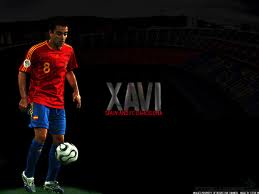
Biography Of Xavi

XAVI

Xavi Hernandez born on 25 January 1980 at Terassa, Spain. Xavi Hernandez, who has pulled the strings in the centre of the field for Barcelona for a decade, was voted the best player at UEFA EURO 2008, with few disagreeing.Aside from his undoubted creative genius, the visionary Catalan is a phenomenally hard-worker who never shirks his defensive responsibilities. Able to occupy any central-midfield role, Xavi's reading of the game is allied to a powerful shot, which ensures he weighs in with his fair share of goals. Also adept at set-pieces, he has the ability to make his team-mates tick, be it at international or club level.Having come through Barcelona's fabled Can Barca during the era of Johan Cruyff and his Dream Team, Xavi has followed in the footsteps of the man who helped knit that glorious side together: current Azulgrana supremo Josep Guardiola. Indeed, it was Xavi who filled in for the injured Guardiola in 1999/00, slotting so well into the role the club had a ready-made replacement for when ‘Pep' left for Italian football. Since then, no matter who has held sway in the Barça dugout, Xavi's status as an automatic starter has remained unchanged. Whatever their various coaching philosophies, nobody has yet been able to do without his eye for a defence-splitting pass, close control in the tightest of situations and willingness to drop back and protect his back four.At the club since the age of 11, the Blaugranas are his one and only team to date, and it would appear unlikely he will stray now given his lead role in arguably Europe's finest footballing side. As far as international duty is concerned, after captaining the Spain side with won the 1999 edition of the FIFA U-20 World Cup in Nigeria, as well as the team which finished runners-up at the Olympic Football Tournament Sydney 2000, he made his senior La Roja debut in November 2000 and has not missed a major tournament since.Xavi is a vital cog in the Spain machine or perhaps the oil that makes it run smoothly. A leader by example, who rarely loses the ball or misplaces a pass, Xavi is a midfield orchestrator par excellence with the ability not only to read the flow of a game but to dictate it in his side's favour.During the 2009-2010 season, journalists increasingly noted Xavi's contribution to the Barcelona side. For example:"Quite simply the best midfielder in modern football, and one of the greatest 'centre' midfielders of all time. It could even be argued that Xavi and Lothar Matthaus are the two best in this position in history. World class for several years now, it is the past three seasons in particular where the 30-year-old has been untouchable. Xavi’s passing is up there with Michel Platini, he creates countless goals with genius through balls while virtually never relinquishing possession."
On 3 June 2010, Spanish newspaper Marca awarded Xavi third place in the annual Trofeo Alfredo di Stefano award for the best player in La Liga, behind only Lionel Messi and Cristiano Ronaldo.
On 9 June 2010, he signed a new 4 year contract with the club, which may be automatically renewed up to 30 June 2010 based on number of games he played.


Friday, 20 July 2012

Biography Of David Villa

DAVID VILLA

David Villa Sanchez (born December 3, 1981 in Langreo, Asturias), nicknamed El Guaje (The Kid in Asturian) is a Spanish football player, who currently plays for Valencia CF and the Spanish national side. Due to his outstanding finishing skills, pace, well-roundedness (he can score from seemingly any position with both his head and feet) and work ethic, he is widely regarded as one of the best strikers in La Liga and in the world. David Villa reputation seems to have flourished ever since his groundbreaking season with Valencia last season.
Villa is married to Patricia and has a daughter named Zaida.
David Villa started his career in 1991 with UP Langreo. In 1999 he moved to Sporting de Gijon until he was signed in La Liga by Real Zaragoza in 2003. After two very sucessfull years with Zaragoza, Villa transferred to Valencia CF in the summer of 2005 for 12million euros.
In the 2005-06 season, he was in top form for Valencia, scoring 25 goals in 35 league matches, to finish one goal behind top scorer Samuel Eto’o of FC Barcelona. He scored his first hat-trick for Valencia against Athletic Bilbao on 23 April 2006.
Villa was included in Spain’s 23 man squad for the 2006 FIFA World Cup in Germany, and was favoured over the more established Raúl, to line up alongside Fernando Torres in the opening match with Ukraine. Villa scored twice (one a penalty) in this game, in his first World Cup finals appearance. He added one more from the penalty spot in Spain’s 1-3 defeat to France in a Round of 16 knockout match. He finished joint 2nd top goal scorer for Spain in World Cup 2006 with 3 goals.

Thursday, 19 July 2012

Biography Of Ricardo Kaka

RICARDO KAKA

Ricardo Kaka was born 22 April 1982, and generally known as Kaká. He is a Brazilian soccer player who plays as midfielder and now participates for Real Madrid C.F. and the Brazilian national team.
He began his career as a soccer player at the age of eight, when he started playing for a local club. Kaká won the Ballon d'Or and FIFA World Player of the Year awards in 2007 while at the Italian club.
An internet discussion forum gives details the nickname as a usually used shortened form of "Ricardo" in Portuguese. Kaká is presumed to have got his nickname for the reason that his little brother Rodrigo can not pronounce the word "Ricardo" when they were young. Rodrigo called his older brother "Caca" which the latter later altered to "Kaká.
The majority Brazilian soccer players derive from poor families and sport is one of their simply ways to get out of this state. Certainly, there are exemptions and Kaka is one of them, as he was born in a rather rich family that supported him to concentrate on both school and soccer at the same time.
Kaka made his international debut in January 2002 in opposition to Bolivia. He was a part of the national team which won the 2002 FIFA World Cup, but did not see much action playing just 19 minutes of the first round game in opposition to Costa Rica.
He ended in joint tenth place in the voting for the 2004 FIFA World Player of the Year award. More recently, he assisted Brazil qualify for the 2006 FIFA World Cup. Kaká has matured as a player and is now regarded as one of the best and famous soccer players from Brazil.
Kaká has been an Ambassador Against Hunger for the United Nations World Food Programme since November 2004. He was the youngest ambassador at the time of his appointment. In 2009 he was chosen the most valuable player in Brazil's successful Confederations Cup campaign. Kaka was the Man of the Match in the final in opposition to USA as well.